How a Kingfisher Helped Shape the Bullet Train
Imagine standing near a railway tunnel as a Shinkansen rushes inside. A moment later, a deep boom bursts from the other end. The train is not breaking the sound barrier. It is pushing a wave of air through the tunnel, creating noise and vibrations that disturbed nearby communities.
Engineer and birdwatcher Eiji Nakatsu saw the problem in a different way. A train moves from open air into the closed air of a tunnel. A kingfisher makes an even harder jump: it dives from air into water, yet enters with barely a splash. Nakatsu wondered if the secret was hiding in the bird’s beak.
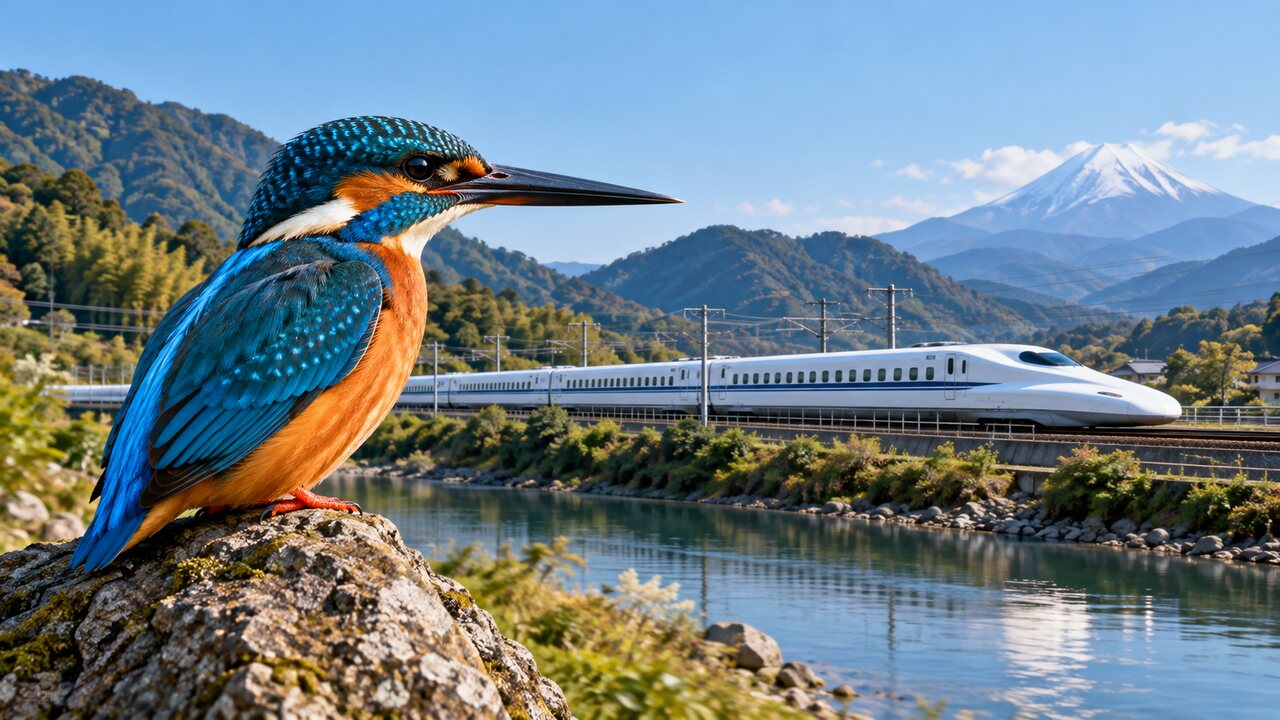
A kingfisher’s beak is long, narrow, and gently widens toward its head. Instead of hitting the water all at once, it parts the water step by step. Nakatsu’s team tested many train shapes with models and computer simulations. The best shape looked remarkably like the kingfisher’s beak.
The result was the 500 Series Shinkansen, with a smooth nose stretching about 15 metres. Its shape pushed the tunnel air more gently, so the pressure wave was smaller and the boom was quieter. A tiny bird had helped solve one of high-speed rail’s biggest environmental problems.
The new shape brought an extra surprise. According to Nakatsu, it reduced air pressure by 30% and electricity use by 15%, even while the train became faster. The engineers did not simply copy a bird. They noticed that nature had already solved the same kind of problem.